
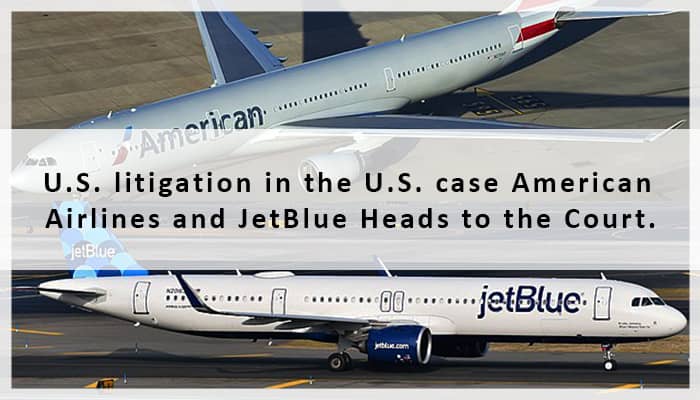
The federal government’s antitrust case in the case of American Airlines and JetBlue begins on Tuesday, and the outcome could determine the extent to which the Biden administration will scrutinize other airline transactions, including JetBlue’s current attempt to purchase Spirit Airlines.
The Justice Department and six states are suing American and JetBlue to end their relationship in the Northeast, which includes New York and Boston. It’s a significant examination of the administration’s opposition to mergers, even though the partnership between American and JetBlue isn’t a complete merger. The government claims that the alliance will decrease competition and result in more expensive rates.
The Trump administration endorsed the alliance. However, The Justice Department began taking a more in-depth look at the alliance just a few days after the presidency of Joe Biden became president.
American and JetBlue claim that the agreement has been in place for nearly 18 months and has enabled each airline to provide new routes that could not be feasible for either airline alone. They argue that they have no proof to suggest that the partnership hurts consumers.
We bring you this news as a means of informing you about long-term transportation issues between Boston and New York. As a taxi service provider from Boston to New York, we are concerned about how this recent event will affect our customers traveling between the two cities.
The former and current Chief Executive Officers from American JetBlue, along with senior officials from other airlines, are among the witnesses the two parties could select. Delta Air Lines tried to stop two executives from appearing in the trial by claiming that they were too busy working in Atlanta, where the airline’s headquarters are and is based, to be able to participate in the trial at the federal court in Boston. The judge on Monday ruled that one of the executive vice-presidents should be present to testify.
U.S. District Court Judge Leo Sorokin has set aside almost three weeks for the trial. There won’t be a jury. Sorokin could take weeks or even months before he can issue the decision, which is most likely to have to be appealed by the side that lost.
When the Justice Department filed the lawsuit in the past year, attorney general Merrick Garland described the American-JetBlue alliance as “an unprecedented move” that could lead to more expensive fares, fewer options, and poor service for passengers.
A top Justice Department antitrust official, Assistant Attorney General Jonathan Kanter, echoed those arguments in an appearance last week before the Senate subcommittee. Kanter said that although new airlines have joined the market in the past and have resulted in lower fares and better service, many were swallowed through the mergers and acquisitions.
“We are determined to fight the practice of consolidating airlines when it violates regulations,” Kanter told the senators. “We are looking closely at the way we approach consolidating airlines … We are also examining many other issues to be reviewed.”
Kanter did not specify what the other concerns are. However, one might be the JetBlue plan to purchase Spirit at $3.8 billion. Spirit Chief Executive Ted Christie, who preferred the merger with Frontier Airlines, fought JetBlue for months by insisting that antitrust regulators should never allow his low-cost carrier to be swallowed by JetBlue, which is a more traditional and expensive airline.
As part of this alliance, American and JetBlue are selling seats on their flights and sharing the profits. They claim they collaborate on the schedules but not on prices. They also offer customers benefit reciprocity in the frequent-flyer program.
American and JetBlue assert that their alliance isn’t a merger but a way to fight United and Delta in the Northeast. The alliance claims to have allowed them to add 50 routes to their network, add flights on existing routes, and increase their percentage in that Northeast market from 16 percent to 24 percent.
The companies claim to be perplexed at the Justice Department’s assertions that the agreement is anti-competitive. “They are not right. We’ll be the proof,” Doug Parker, the American CEO at the time, stated when this lawsuit was filed. He claimed that preventing the agreement will “take away the consumer’s choices and hinder competition, and not help it.”
The government believes that the alliance will cut down on airline competition and could cost customers hundreds of millions of dollars annually. JetBlue was previously considered a “scrappy rival” and the most unfriendly American rival within New York.
“But this is the moment, JetBlue has sold out and has cashed in,” government lawyers said in a filing. The government claims that American and JetBlue will dominate more than 50 percent of the market, often more than 80%for routes between New York and Boston, where they competed previously head-to-head.
The Justice Department seems to be showing buyer’s remorse over many earlier airline mergers, which mainly went unchallenged. The deals eliminated Continental, Northwest, U.S. Airways, AirTran, TWA, and other airlines. They also degraded hub airports that were once bustling, like St. Louis, Cleveland, and Pittsburgh.
Consumer advocates claim that mergers have resulted in higher costs and less service, especially from the four major carriers: American, Delta, United, and Southwest.
“They have become too big to fail and too large to take care of,” said Bill McGee, an expert on aviation for the American Economic Liberties Project. This organization is opposed to concentrated power in industries. “We believe there ought to be a moratorium on any mergers within the aviation sector till (federal regulators) examine the negative impacts of the consolidation.”
Sen. Richard Blumenthal, D-Conn. The senator declared in the last week that an absence of competition led to numerous flight issues that caused a lot of stress for passengers this summer.
“Americans are furious beyond belief about delays and cancellations caused by airlines, and they are starting to realize the reason airlines do not treat them well and the reason they’re not managed properly is due to consolidation,” a customer of Boston Airport Express MA said.
It’s long due that justified action is taken for the airlines to function correctly. Boston airport Express MA has experienced several instances where a customer had to cancel a cab because their flight was canceled or they needed a quick ride from the airport back after being notified of the cancellations.
